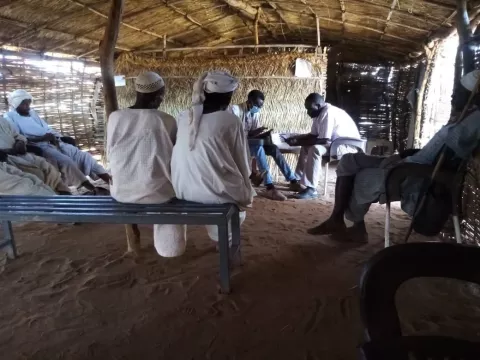

LEDCs were established at state level in East Darfur and West Kordofan to localize programming and facilitate interventions to support rural livelihoods under PROSPECTS even during conflict.
As a mechanism to localize its approach to Employment-Intensive Investment Programmes (EIIP) in Sudan, the PROSPECTS team set up LEDCs at state level in East Darfur (Assalaya) and West Kordofan (Keilak and Muglad). These included representatives from state-level ministries, employers’ and workers’ organizations, local financial institutions and vocational training centres. The main objective of the LEDCs was to transfer relevant knowledge and skills for ensuring coordinated and locally appropriate interventions to support rural livelihoods under PROSPECTS. Three LEDCs were formed and underwent a period of training. They convened on a quarterly basis and submitted action plans for coordinated information-sharing and exchange. The action plans commonly involved access to remote field locations, monitoring and providing feedback on work progress, and developing evidence-based recommendations to strengthen programming. These were reviewed by the PROSPECTS team and used to determine support costs that the LEDCs would require. The plans, and associated capacity-building for LEDC members, helped the programme localize its operations. In terms of EIIP, this served to support the identification of relevant infrastructure work and localized monitoring and oversight functions. The LEDCs continued to meet in the early phases of the resurgent conflict, and helped the ILO maintain PROSPECTS even as access to project sites was interrupted for PROSPECTS staff.
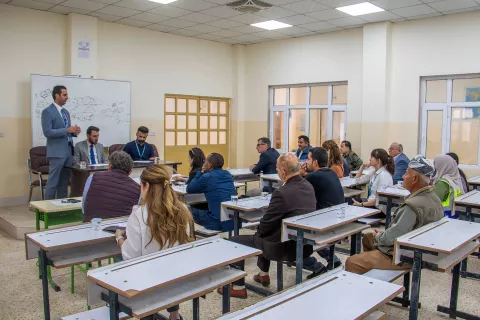
A digital monitoring tool, piloted in Iraq's Kurdistan region, enabled young engineers to monitor EIIP sites, ensuring quality and safety standards, while providing valuable digital work experience.
In Iraq, a simplified digital monitoring tool was introduced and used by young engineers to carry out monitoring and reporting on Employment-Intensive Investment Programmes (EIIP) sites. The tool was designed to ensure adherence to quality of work, alignment with environmental and social safeguards, and safety standards across project sites, while also introducing a technology that would allow young people to gain work experience using digital skills. Both project sites in Dohuk and Mosul had large universities with engineering departments which produced a large pool of graduates seeking practical work experience. To capitalise on the talent pool and introduce monitoring tools that captured information in real time, survey information was uploaded to Kobo Toolbox. This included technical aspects to measure the project’s implementation, as well as social and environmental elements. The tool was already in use by other humanitarian and development actors in the area. The tool was first introduced on green work sites in the Kurdistan region, with young engineers from the University of Dohuk. After a successful roll out on project sites in Dohuk, it was rolled out in Mosul. Here, it proved particularly useful for continuous monitoring when PROSPECTS staff could not access project sites, owing to security requirements that made travel more costly and time-intensive. The tool is now used for all EIIP programmes across Iraq and the team is looking at ways to institutionalize it in governmental public works programmes.
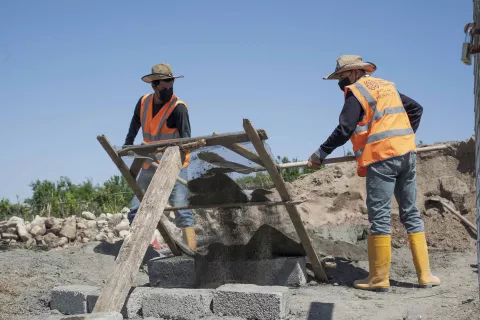
Engaging trade unions in a technical committee led to joint wage recommendations and demonstrated the potential for greater refugee representation within Employment-Intensive Investment Programmes (EIIP).
The approach taken in Iraq also involved trade union participation, through the creation of a technical committee to oversee and guide the programme. The direct involvement of the trade unions saw them take on a role to solve issues to do with decent work, in partnership with the government. The leadership role of the unions positioned the ILO as a convenor, enhancing the authority of the social partners. The unions also played a role in advising EIIP workers themselves and supported the election for worker representatives on project sites. The elected representatives pushed for the development of a recommended wages list for 20 occupations in the construction sector. A recommended wages list was drawn up jointly with the construction workers’ union and contractors’ association in Dohuk, providing a positive example of local partners taking on responsibility and ownership. It also shows the potential for EIIP workers to take on greater responsibility as worker representatives and build cohesion by advocating collectively for a shared benefit, such as standardized wages.
When developing and supporting market systems in the PROSPECTS programmes, cultural norms played a part in determining who participated in which type of labour activities and how. For instance, in Uganda, Kenya, Sudan and Egypt, a gender dimension in the selection of value chains was apparent: in Kenya and other East African countries, women were traditionally more involved in caring for and milking small livestock or camels and in selling the associated products, while men were more involved in decision-making regarding the sale or purchase of large livestock. Moreover, men were still largely in control of household budgets and profits generated from sales. In Egypt, the assessment of the care and food-services value chains highlighted a substantial representation of women, especially in the most informal and microenterprises. Therefore, gender differences need to be taken into consideration when engaging with local communities in creating suitable interventions that are inclusive. For example, the Kenyan PROSPECTS team adopted a market systems approach to strengthen the camel-milk value chain. The establishment of the Kasha Camel Milk Collection Centre empowered women through entrepreneurship, raising hygiene standards and expanding market access.
In Ethiopia, youth-led organizations were provided with financial and capacity-building support via a competitive grant scheme, the Youth-to-Youth Fund. The fund supports youth-led initiaties that addressed challenges in their communities while promoting employment opportunities for young people. One of these organizations, Safe Light Initiative, provided entrepreneurship, employability and leadership training to young people.
In Uganda, PROSPECTS helped build on a social entrepreneurship education programme run by UNICEF. RYLOs were engaged in integrating SIYB into UNICE's UPSHIFT model, focusing on the modules for starting up businesses. What became known as integrated UPSHIFT (i-UPSHIFT) supported young entrepreneurs in the Nakivale and Rhino settlements to develop business ideas based on community needs.
The programme in Lebanon trained more than 650 young people – male and female – through its My First Business entrepreneurship programme. Find out more in the case study.
Find out more about the PROSPECTS programme’s wider learning on youth engagement.
Gender and disability inclusion
The programme team partnered with the Uganda Women Entrepreneurs Association Limited (UWEAL) to roll out the Start and Improve your Business (SIYB) and GET Ahead training in the Rhino and Nakivale settlements. UWEAL is a membership-based organization, representing some 80,000 female-owned small, medium and large businesses in Uganda. The refugee and host community female entrepreneurs who were supported by UWEAL under PROSPECTS were also registered as members of the association, so they were able to avail of a support structure and network in the long term.
Based on the ILO’s training material, a refugee youth-led organization in Uganda, Unleashed, developed a module specifically designed as a stand-alone programme for women, called U-Leadies, as part of its enhanced BDS offerings. The organization was ultimately contracted by the ILO to implement BDS training in Nakivale, which provided it with practical experience in project design, implementation and administration. Find out more in the case study.
The Digitalize your Business (DYB) training tool is specifically designed to provide practical guidance on using e-commerce to sell products and/or services online and digitizing business processes. It was initially developed as part of Egypt's digital transformation, accelerated by the COVID-19 pandemic, as a complementary module to the existing SIYB package. Following its success, it was adapted in Uganda and Kenya, with other modules added to suit the local contexts.
Check out the video on DYB produced by the RYLO in Uganda here.
This video shows how four young people in Jordan developed new skills and found their career paths through the Job Search Club (JSC) initiative.
In this documentary, Al Harith, Issa, Abeer, and Malek share their stories, challenges, dreams, and the success they have now achieved. And these four are not alone; across Jordan, more than 1,400 Jordanian and Syrian young people have completed the intensive, career-focused training included in the JSC curriculum implemented by the ILO, UNICEF, and the Business Development Centre (BDC) in collaboration with the Ministry of Youth.
Find out more about the PROSPECTS programme’s wider learning on youth engagement.
The PROSPECTS Jordan team successfully adapted and implemented the Job Search Club (JSC) model in partnership with UNICEF and the Jordanian Ministry of Youth to address high youth unemployment, incorporate national policies, and include a focus on green jobs.
In 2019, the Jordanian Ministry of Youth (MOY) launched its National Youth Strategy, which called for a focus on increasing the availability and reach of services to young people through MOY centres. Following the COVID-19 pandemic, youth unemployment, that is, among those aged 15 to 24, exceeded 46 per cent; as of 2023, it remained at just over 41 per cent. This drew national attention to the situation of young people and confirmed the need for more concerted support. The MOY National Youth Strategy highlighted links to Jordan’s Vision 2025, a detailed socio-economic plan put forward by the King, entitled “Developing career guidance, employment services and changing business culture”. With these policy elements in place and against a backdrop of high youth unemployment, the PROSPECTS Jordan team adapted the JSC model from the programme in Egypt and applied it in partnership with UNICEF, using the MOY youth centres as spaces in which to convene the clubs.
Adaptation of the tool began in consultation with the PROSPECTS team in Egypt, along with the JSC master trainer in that country. The MOY in Jordan approved adaptations and provided feedback in the process. The version adapted for Jordan took into consideration labour market governance, particularly policies governing refugees’ access to specific trades and occupations. This included work-permit processes, sectors that were “closed” to foreigners and regulations to register a business. Because Egypt and Jordan shared the same language, similar cultural contexts and groups of refugees, the adaptations were relatively easy to make.
Taking the example of Egypt, the PROSPECTS Jordan team established a partnership with the MOY. It did so jointly with UNICEF, whose mandate lent itself to the activity. It established a UN-to-UN Agreement with UNICEF for the JSCs, with UNICEF transferring funds to the ILO to apply and implement the methodology. Under this collaboration, UNICEF used its partnership with the MOY to secure youth centres as spaces in which to convene the clubs. It also conducted outreach activities related to the JSC among youth groups and youth-led organizations. The ILO was responsible for adaptation, application and follow-up. Both organizations appointed country-based staff as focal points to ensure coordination and oversee day-to-day operations.
The JSC started with training for facilitators, led by the master trainer from Egypt and including staff from UNICEF, the ILO, MOY and the partner selected to implement the clubs, the Business Development Centre. The week-long training covered the role of facilitators and skills for successful facilitation, supporting job-search functions and providing job-seekers with information on job vacancies and skills requirements. Given that the clubs would bring together both refugees and members of the host community, attention was given to addressing social cohesion between these groups.
In the pilot phase, 20 clubs were set up across the three largest refugee-hosting governorates. These included clubs inside the Zaatari and Azraq refugee camps. Each started with ten days of training, providing skills to build the employability profile of participants, followed by coaching and peer-to-peer support.
The pilot served as proof of concept, which enabled the MOY to pilot it and scale it up. By engaging the MOY directly in the adaptation and facilitator training, the Ministry’s ownership of the methodology was reinforced. The Ministry subsequently endorsed JSC as a method to deliver the aims of the National Youth Strategy. JSCs responded to real needs, namely, very high youth unemployment among both host and refugee communities in the country.
After the pilot, the JSC methodology was further adapted to focus on “green” jobs. This was partly influenced by the Ministry of Labour’s National Employment Plan 2023, the aim of which is for 10 per cent of all jobs in the Kingdom to be green by 2030. An accompanying green jobs assessment also demonstrated the current and anticipated potential for green jobs in Jordan’s agriculture, energy, manufacturing, tourism, transport, waste management and water sectors. The format of the clubs remained similar to those convened in the pilot phase but introduced the concept of green jobs and how these contribute to environmental preservation and restoration. In two cases, green JSCs were convened in universities, which provided a pool of qualified refugee and Jordanian youth in the process of pursuing green professions. In addition, a job fair was organized with private sector employers in green sectors and enterprises.
The evolution of JSC in Jordan illustrates a model that is linked to national policies and processes, while also considering genuine labour market challenges faced by young people. The methodology was relevant and beneficial to both refugees and host community members, with both groups reporting similar levels of employment directly after their participation in the clubs.
Read success stories of JSC graduates and facilitators: