

EIIP supports the dairy value chain

Ethiopia
Focus
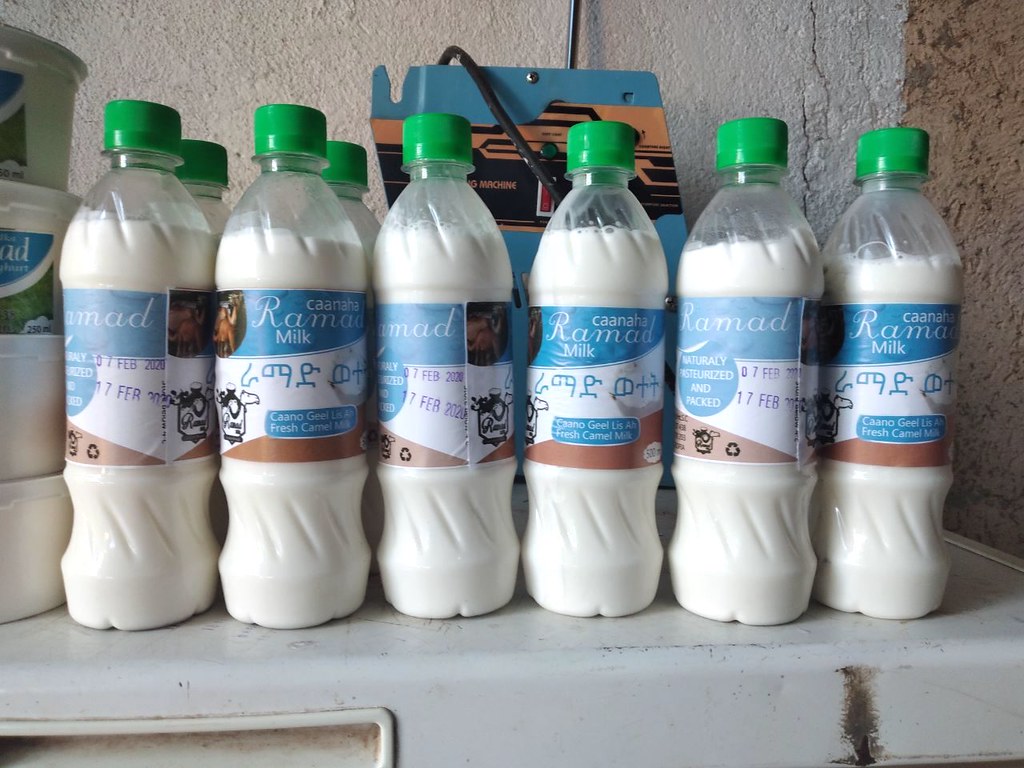
PROSPECTS used Employment-Intensive Investment Programmes (EIIP) to construct water and milk storage facilities to improve livestock rearing and milk production, while also building capacities building and providing local employment opportunities.
In 2019, in the Fanfan Zone of Somali Regional State and Jigjiga, PROSPECTS extended the EIIP approach followed as part of a wider value-chain development programme. This extended approach focused on enhancing the livelihoods and added value of livestock-rearing and milk production. After an assessment of challenges and bottlenecks in the value chain, animal health and milk productivity were identified as areas of focus. A key issue within these was water access during dry seasons, which is a major determinant of both the quality and quantity of milk produced.
Because the EIIP approach was new in these areas, the intervention included a period of capacity-building and awareness-raising around the EIIP approach, involving district-level officials, private sector contractors and workers. PROSPECTS collaborated with the Bureau of Pastoralist Development and local administrators on such issues as land acquisition, community mobilization and handover to the local community at the end of the EIIP. The Bureau was also overseeing work as part of the wider value-chain development programme and so could advise based on a wider objective to develop the market.
To address the issue of water scarcity in dry seasons, two detention ponds were constructed using do-nou technology, a Japanese method that uses gunny bags filled with sand or soil and compacted manually to level and reinforce dirt roads. This is a durable, yet simple technology, the materials for which can be sourced locally. Additional facilities included water points and cattle troughs. Two technicians were also trained as community resource personnel, to provide support and maintenance after the construction ended.
To address productivity bottlenecks the PROSPECTS team and the Bureau of Pastoralist Development jointly prioritized cooperative development, the construction and enhancement of milk-storage facilities, and improvements to road infrastructure. A milk collection and cooling facility was constructed so that milk would have a longer shelf life and be preserved during transport to nearby markets. Water sources were constructed so that livestock would have water all year round in the arid climate, while the pooling and storage facilities prolonged the shelf life and hygiene of the milk.
The cooling facility was designed according to national standards and requirements set by the Ministry of Agriculture and Livestock. It was constructed by local contractors from Somali Regional State, who, in turn, employed refugee and host community members from the surrounding area. In all, 134 community members worked on the EIIP construction, while approximately 585 individuals and approximately 5,080 animals had access to the improved facilities.
Continue reading
Case study
Local Economic Development Committees (LEDCs) and localized programming

Sudan