
Digitalizing refugee and host community businesses in Egypt

Egypt
Focus
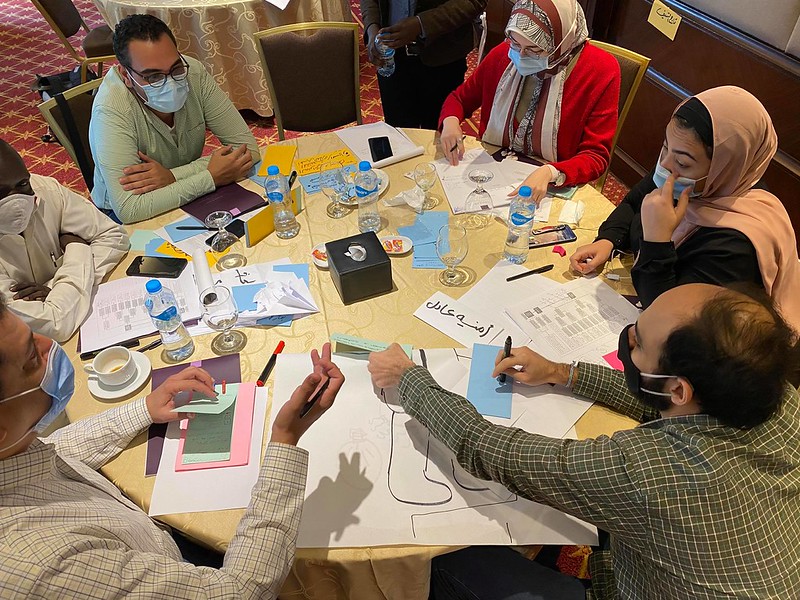
The Digitalize your Business (DYB) initiative in Egypt was developed to support micro and small enterprises run by refugees, by offering services like legal counselling, coaching, networking and specific technical guidance.
Egypt's digital transformation was accelerated by the COVID-19 pandemic, which forced the introduction of new services and business opportunities through e-commerce, digital services and platform work. These aligned with national initiatives such as Egypt Vision 2030. However, micro and small enterprises, including those run by refugees, faced barriers in fully availing of the benefits of the digital transformation. This was partly because of connectivity issues, lack of formal registration and low levels of digital literacy. To address these issues, PROSPECTS Egypt developed a complementary training tool to the SIYB core package. This included practical guidance on the digitalization of business processes and operations, including the use of e-commerce to sell products and/or services online. This was later adapted in Uganda and reformulated in Kenya to address issues related to data privacy and security.
Digitalize your Business (DYB) in Egypt covered the basic requirements and main steps for getting existing or future businesses online through three core modules:
- Developing an online presence
- E-commerce
- Digitalizing business processes.
DYB targeted micro, small and medium-sized enterprises. Refugee and host community entrepreneurs who wished to participate were expected to have basic computer skills and be familiar with internet usage. Read more about the programme in the Digitalize your business teaching manual in Egypt.
DYB was rolled out in Damietta, Greater Cairo and Alexandria, starting with a needs assessment and market research. These processes helped identify opportunities for digital adaptation in MSMEs. The training itself was accompanied by legal counselling, coaching, networking and specific technical guidance relating to the sector or area of business operation. The training also referred participants to additional social, health and livelihood services outside of PROSPECTS, facilitated by partnering INGOs.
While the programme wanted to make sure at least 30 per cent of its beneficiaries were refugee entrepreneurs, the practical barriers faced by the latter necessitated a more proactive approach. Generally speaking, Egyptian-run enterprises were more exposed to digitalization than those run by refugees. The latter also faced different vulnerabilities owing to their inability to register businesses formally. In this respect, trainers had to cater to the different needs of the participating enterprises, highlighting the importance of dedicated business coaches and different follow-up support, such as legal counselling.
The relevance of DYB in refugee-hosting contexts was highlighted by the fact that the programme in Uganda adapted the tool and built on training it had delivered in 2023, called Digital Tools for Business Growth. Two SIYB master trainers were trained on the adapted DYB tool and went on to train 20 DYB trainers in PROSPECTS target locations. The programme in Kenya also made its own adaptation, drawing on content that highlights data protection and digital risks.
Find out more about the PROSPECTS programme’s wider learning on the digital and gig economies.