

Combining push and pull interventions

Uganda
Focus
Lessons from the PROSPECTS Uganda-Ag-Ploutos partnership using both push and pull interventions
PROSPECTS Uganda conducted an AIMS assessment that identified challenges and opportunities in supporting sesame and cassava value chains, highlighting their potential to provide livelihoods for refugees and host communities. The assessment identified several constraints, including inconsistent and low-quality input supplies, a lack of downstream agri-dealers or agents, inadequate farming practices, inconsistent supply for aggregation, poor post-harvest handling and limited market access. In response, the project began identifying private sector partners with the capacity and commercial incentive to engage with farmers in these underserved areas. Through an open call, Ag-Ploutos was selected as a partner.
Ag-Ploutos is an agricultural company that specializes in strengthening food supply chains by collaborating with public and commercial entities, including governments, cooperatives and farmers. Through its agent network it provides aggregators with quality inputs, extension services, financing, crop insurance and access to credible markets. The company had already identified a business opportunity in expanding its reach to 30,000 farmers in new territories and had already planned to expand into the West Nile region to increase its pool of quality sesame suppliers for high-end export markets. As the company’s manager explained to the programme team, it would have eventually expanded into West Nile with or without PROSPECTS’ support; however, the opportunity to work together substantially accelerated its penetration of the local market, enabling it to achieve its expansion goal in just one year instead of three. This also demonstrated that the business case was sound and aligned to the company’s own objectives.
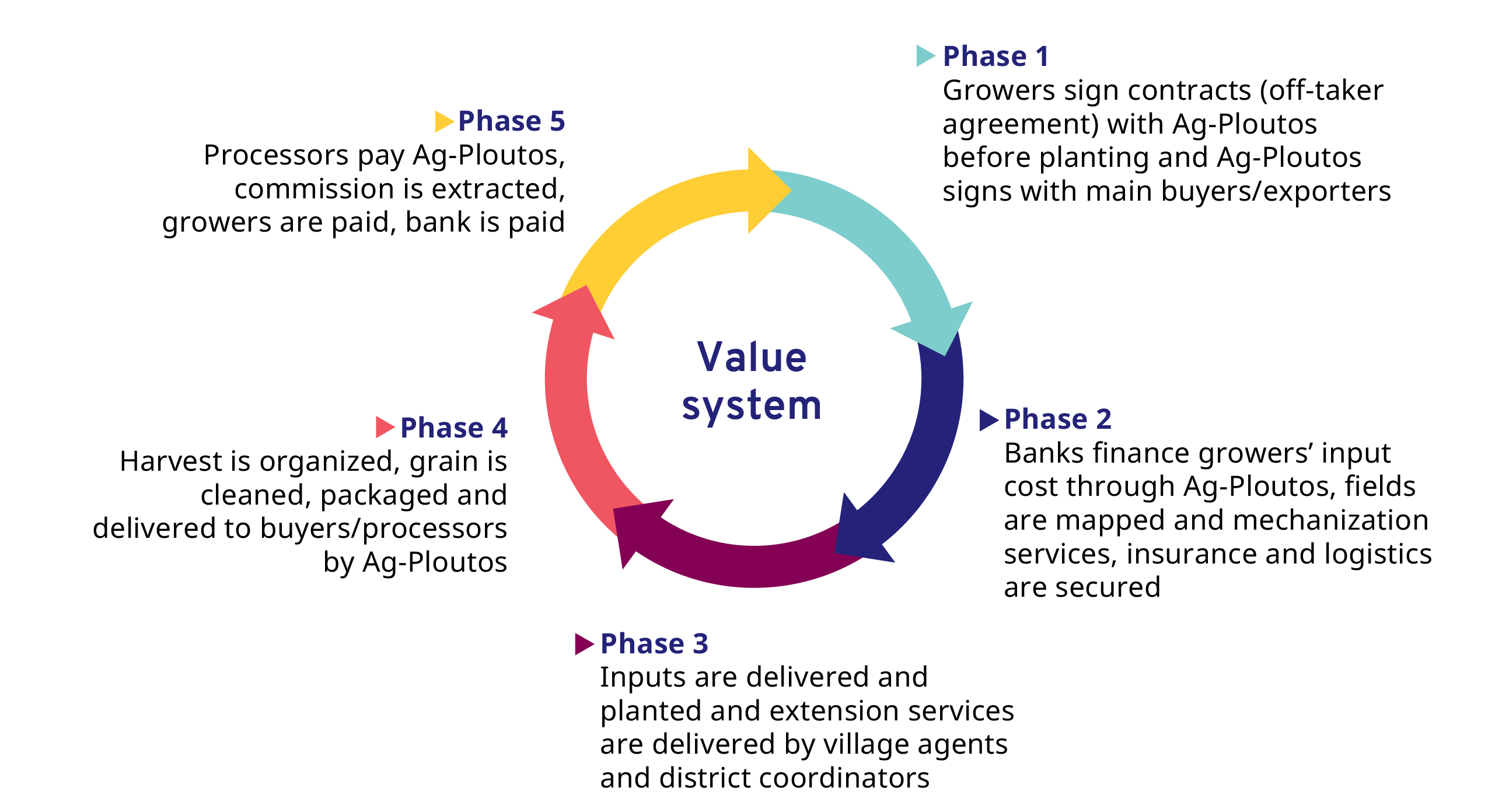
The model that was developed with Ag-Ploutus can be broken down into five phases. The graphic above illustrates these and clearly shows how the partnership facilitated access to export markets by de-risking transactions between large export buyers, banks and small-scale farmers. The phases were as follows: 1) the grower signs contracts with Ag-Ploutos, which, in turn, signs contracts with export buyers; 2) based on the guarantee provided by these contracts, local banks agree to finance growers’ input costs through Ag-Ploutos, which will recover the loan on behalf of the bank. At the same time, fields are mapped and mechanization services, insurance and logistics are secured for the growers; 3) inputs are delivered and planted, and extension services are implemented through a network of trained village agents and district coordinators; 4) village agents buy back the sesame production from farmers, deducting a pre-financing cost of the inputs from the total. Ag-Ploutos aggregates the sesame harvest locally and has it cleaned, tested and packaged in Kampala; 5) export buyers pay Ag-Ploutos, a 5% commission is extracted for the village agents and the loan to the banks is paid back.
Alongside the extension services, the programme team facilitated training with the National Organization of Trade Unions to train farmers in occupational safety and health. This addressed decent-work deficits observed at the farm level and served to support compliance with export buyers’ requirements.
Because the farmers involved were small-scale and largely unregistered, Ag-Ploutos also developed a digital profiling tool for the farmers, accompanied by an evaluation tool. The profiling tool provided basic information about the farm, such as crops grown and geographical area of operations. The evaluation tool allowed farmers to receive ratings from buyers, which helped legitimize their operations. The evaluation tool was also expanded to predict productivity potential of the farms and evaluate compliance with labour standards. The two tools were adopted by banks for the purpose of due diligence, which also helped previously unbanked farmers access finance. 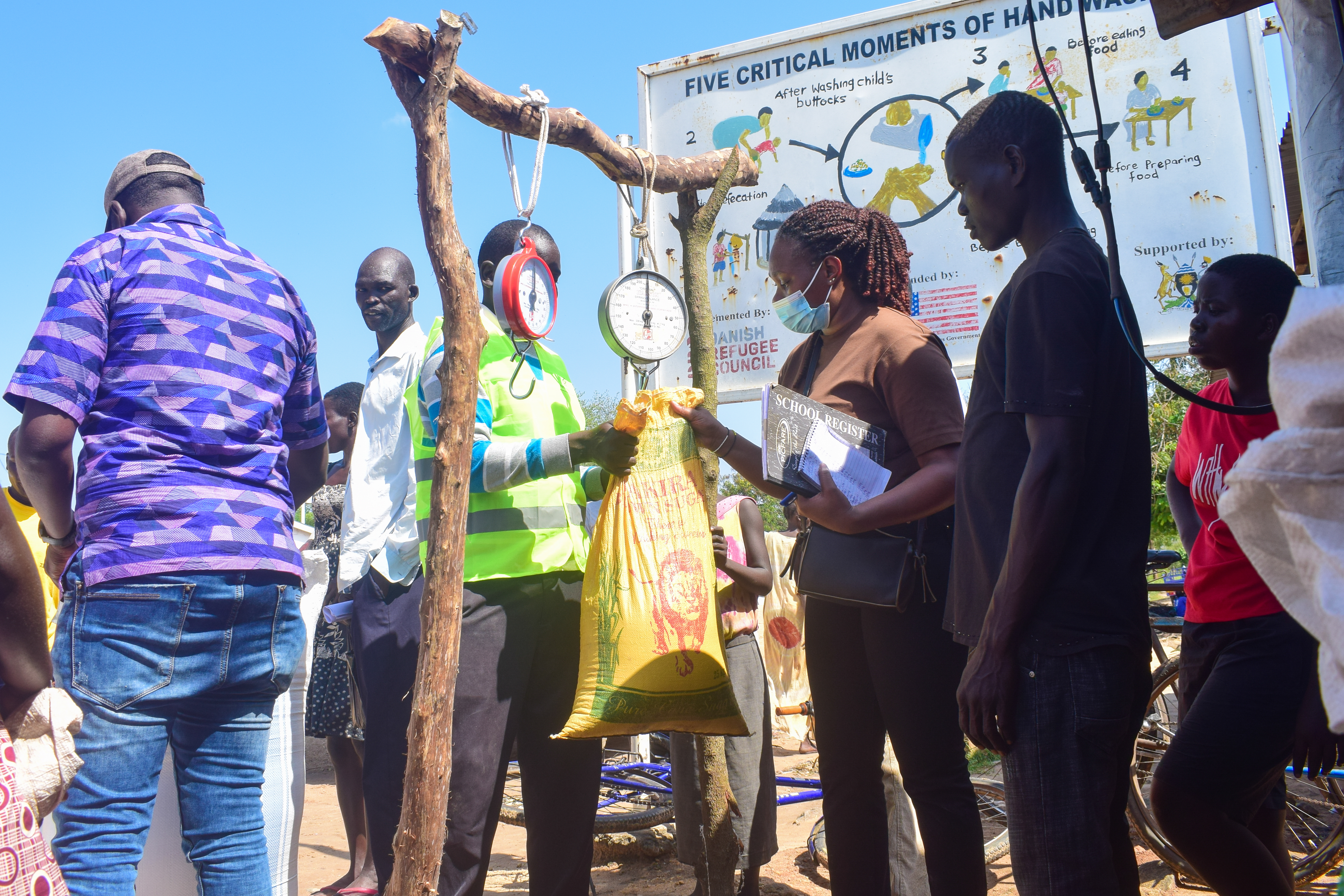
Results:
- In all, 5,740 refugees and host community farmers had access to inputs and extension services, as well as guaranteed access to export markets.
- In one season, 350 tons of sesame worth US$420,000 were produced and aggregated.
- The new seed variety introduced by Ag-Ploutos improved farmers' yields, increasing them from 100 kilograms per acre to 500 kilograms.
- Farmers’ revenue increased by a minimum of 150,000 Ugandan shillings (US$40) and up to 800,000 shillings (US$216) in one season.
- In total, 890 individual bank accounts were opened for farmers at Equity Bank.
- Overall, 215 businesses were started in the sesame value chain.
Find out more about this project in these reports:
- Piloting Private Service Provision to Refugee and Host Communities in Uganda (ILO)
- Paving the way for better jobs and improving livelihoods for refugees and host communities in Arua, Uganda (ILO)
- Rapid Market Assessment of Five Value Chains in Nakivale Refugee Settlement and Host Community in Isingiro District (UNHCR)
Continue reading
Case study
Market-based skills training in dairy farming – a success story

Lebanon