

Inclusive national RPL framework

Kenya
Focus
PROSPECTS helped design and develop an inclusive RPL system to certify the skills of refugee and host community workers.
The value of RPL has long been recognised in Kenyan legal and policy frameworks. The National Industrial Training Authority (NITA), part of the Ministry of Labour and Social Protection, has implemented a type of RPL since the 1960s, in the form of Government Trade Tests. In an effort to standardize these tests, the Kenya National Qualification Framework Act No. 22 of 2014 mandated the Kenya National Qualifications Authority (KNQA) to coordinate the development of national policies on RPL. A national policy was drafted in 2018, but not implemented. PROSPECTS responded to this gap in application by supporting the KNQA and relevant national bodies to develop a framework, implementation guidelines and assessment tools that were piloted with groups of refugees and host community members.
Under PROSPECTS, the ILO’s first line of support was to the Ministry of Education, through the KNQA,
and involved setting up a National Implementation Committee on RPL (NIC-RPL) and a National Advisory
Committee on RPL (NAC-RPL) and building their capacities. The next stage involved providing technical
assistance and guidance on developing an RPL policy framework and implementation guidelines. In doing
so, the PROSPECTS team was able to encourage the inclusion of language that made the extension of RPL
services to refugees and asylum-seekers explicitly. This then provided grounds for piloting in the refugee hosting
areas of Garissa and Turkana Counties, particularly as PROSPECTS Kenya already had memoranda
of understanding with the County governments.
To give practical effect to the policy framework and guidelines, support was also provided for capacity-building
and piloting. Fifteen members of the NIC-RPL received training and extended coaching sessions,
which proved critical in the development of RPL national training standards and practitioners’ guidelines.
In May 2021, an RPL assessment conducted in collaboration with the NITA and the TVET Curriculum
Development Assessment and Certification Council identified five occupational profiles for a pilot
intervention: textiles, automotive mechanics, welding, hairdressing, beauty therapy and agriculture. In all,
38 young refugee and host community members were assessed in these different occupational profiles.
Following the pilot, the Cabinet approved the RPL policy framework in April 2022, preparing the ground
for country-wide implementation. In the same month, the ILO supported the development of a national
implementation plan, in which stakeholders from, among others, accreditation bodies, TVET colleges and
employers’ and workers’ organizations participated. In May 2022, a costing exercise was commissioned
to calculate the Differentiated Unit Cost of RPL, in order to determine the cost of RPL processes and
put forward recommendations for financing models. PROSPECTS also provided technical assistance to
identify occupations that required proof of competency in sub-sectors that were attracting foreign and
domestic investment and that showed potential for considerable decent-job creation. This helped focus
efforts on operationalizing RPL based on demand and contributions to economic development.
The ILO also provided support to train national RPL practitioners on assessment tools and methodologies to scale RPL nationally. This included the development of an RPL Management Information System with the KNQA and TVET Curriculum Development, Assessment and Certification Council (CDACC). The MIS was integrated into all TVET CDACC centres nationally, including in Turkana and Garissa counties. PROSPECTS also trained and accredited RPL assessors, facilitators and verifiers. This included development of an RPL Practitioners Continuous Professional Development (CPD) curriculum at the national TVET trainers college, the Kenya School TVET (KSTVET).
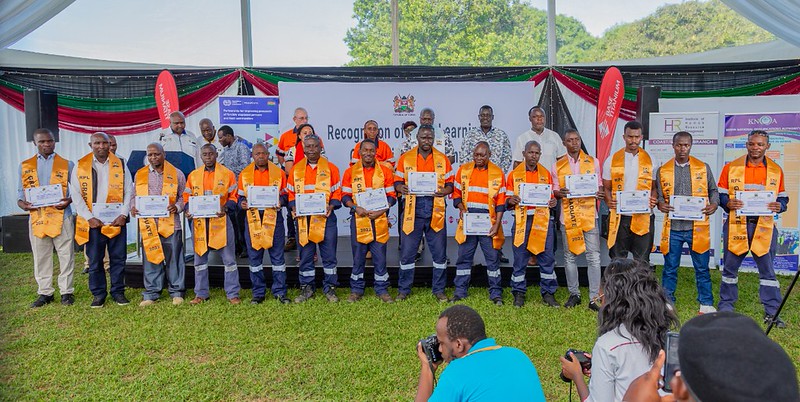
As of April 2025, he national RPL system that PROSPECTS has helped operationalize certified 4,741 candidates, of which 905 were refugees. In one pilot, PROSPECTS collaborated with
Base Titanium, a subsidiary of an Australian mining company, whereby 28 refugee and host community
employees of the company were assessed, 22 of whom were found to be competent and so were certified
through RPL. This helped the employer facilitate the movement of staff between its various locations in
Kenya and abroad. Other private sector actors, such as Kengen (an electricity producer) and the Kenya
Power and Lighting Company, invested their own resources in implementing RPL exercises and having
their employees assessed.
The PROSPECTS team also coordinated with other donors in Kenya to encourage them to include RPL as part of the skills development programmes they were funding. In the absence of RPL, individuals trained through these donor-funded projects would ultimately lack formal certification. PROSPECTS complemented activities under the Swiss-funded Skills for Life programme in Kakuma, for example, by certifying trainees through RPL, so that they graduated with a qualification.
Building on its active role in supporting the development and rollout of RPL, PROSPECTS Kenya leveraged opportunities to invest in further RPL curriculum development. For example, the ILO had established a partnership with an ICT training organization, Learning Lions, to train young people in coding, web design and animation. However, the certificate issued at the end of the course was not nationally recognized. In collaboration with the Technical and Vocational Education Training Authority (TVETA), PROSPECTS supported a review of the Learning Lions curriculum and used this as a basis to establish an RPL curriculum in creative design and web development. Refugee and host community trainees then had the opportunity to access the national RPL process and have their credentials certified.
Read about success stories:
- Kenya’s Journey to Recognizing Informal Skills: The Making of the Recognition of Prior Learning Policy
- ILO and Partners Bring Industry-Recognized Digital Skills Certifications for Kenya’s Youth
- Bringing recognition to the skills of informal “Jua Kali” sector workers in Kenya
- From volunteer to firefighter: Sara's journey of saving lives with Recognition of Prior Learning
- Transforming informal skills into formal opportunities: Theresa's journey of self-empowerment in Kenya
- Rising from informal work to a government employee: the story of Florence Wambui
- Success story: how obtaining a cosmetology diploma opens new doors
Find out more about the PROSPECTS programme’s wider learning on the digital and gig economies.