
Developing an enabling environment for entrepreneurship financing in Iraq

Iraq
Focus
PROSPECTS Iraq successfully enabled financial inclusion for MSMEs run by IDPs and host community members through an innovative loan product and adapted financial training for Central Bank of Iraq (CBI) and commercial bank staff.
Iraq has a history of instability, tied to internal and external geopolitics. As a result of the Gulf and Iraq wars, and subsequent waves of violence, large numbers of IDPs and waves of returnees have characterized much of the displacement context. Unlike other countries in the region, in Iraq the number of refugees is relatively small. Many of the areas with large numbers of returnees suffer from weak infrastructure and labour markets. Iraq’s economy remains dependent on the oil sector, with limited private sector opportunities. Entrepreneurship is also underdeveloped and the use of financial services to start and expand small businesses is extremely limited. However, in recent years, the Government has tried to support the development of MSMEs, partly in an effort to diversify the economy away from the oil sector and realize job-creation potential at the local level.
The national One Trillion Initiative was launched in 2016, whereby private banks were invited to service MSMEs with loans. Under the initiative, the Central Bank of Iraq (CBI) would advance the loan amount at a very low interest rate to encourage participating banks. However, the weakness of the financial sector, with its history of collapse, limited the initial impact, as entrepreneurs were reluctant to take on loans and commercial banks saw the potential client group as high risk, because it lacked the required collateral/guarantees. Consequently, the banks maintained unaffordable and inflexible guarantee requirements.
At the outset of PROSPECTS, the ILO launched an assessment of the demand for and supply of financial products in Iraq. The assessment revealed a weak ecosystem of enterprise support and rampant misperceptions on the part of FSPs vis-à-vis MSMEs, and vice versa. The programme therefore focused on strengthening networks of FSPs that were willing to adapt and extend services to refugees, IDPs, returnees and host community entrepreneurs and, subsequently, building their capacity to work with this client group.
PROSPECTS Iraq adapted the Making Finance Work for Refugees, Displaced and Host Communities (MFWR) course and rolled it out with staff of the CBI, ICBG, MFIs and commercial banks. It also invited staff to FE training with groups of refugees, IDPs, returnees and host community members. In some instances, commercial banks and credit agents became FE trainers themselves. This was also a measure to support the continued application of FE within nationally based institutions by enhancing understanding of the target groups’ needs.
PROSPECTS Iraq worked with FSPs to develop a wider network of enterprise support, encompassing the Ministry of Youth and Sport (MOYS), the Ministry of Labour and Social Affairs (MOLSA), business associations, chambers of commerce and chambers of industry. MOYS youth centres and MOLSA TVET centres were used as training spaces, and staff served as trainers for both SIYB and FE. This helped link financial services offered by the FSPs to other forms of BDS support. The programme also institutionalized the tool within a youth volunteer organization that was affiliated to MOYS.
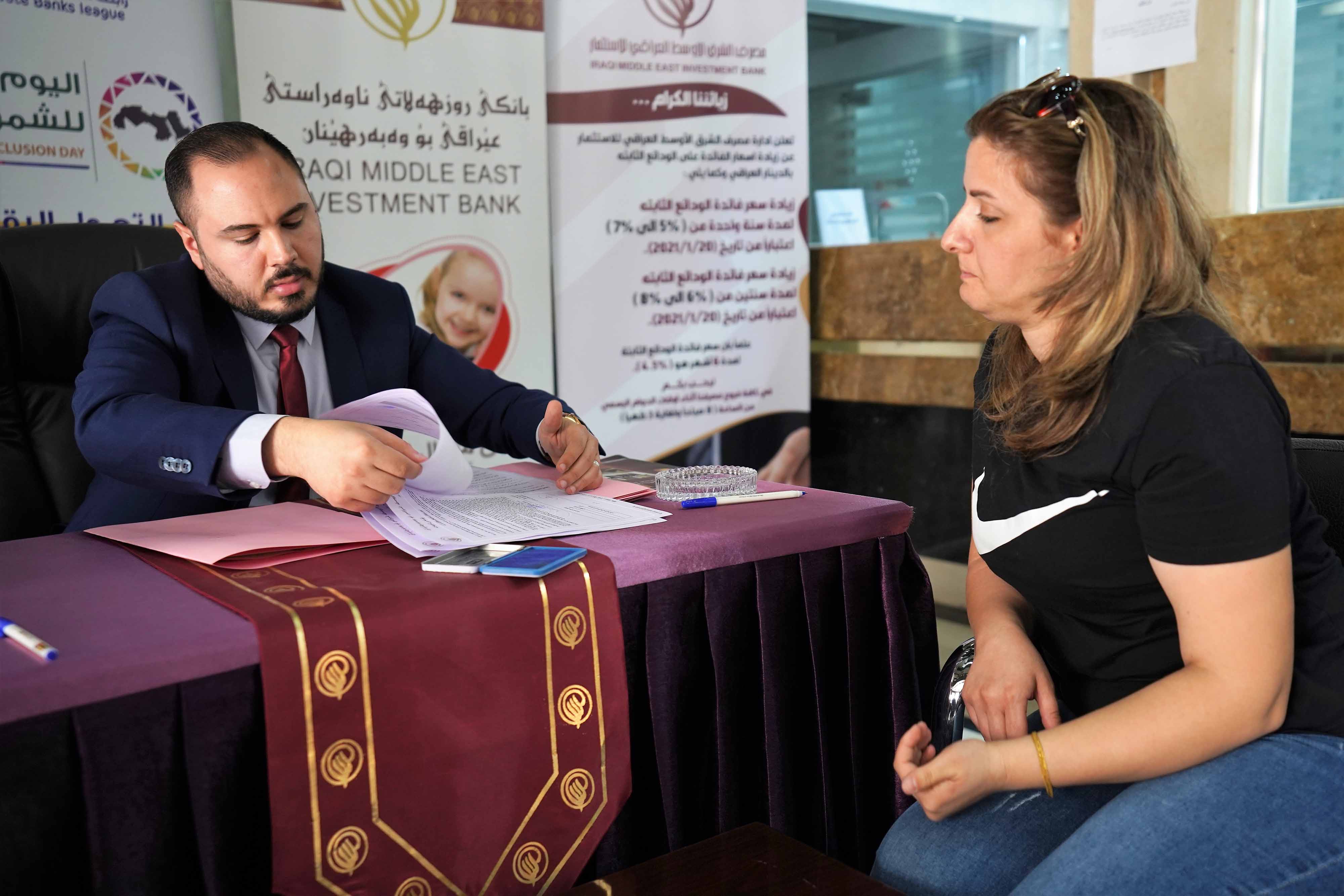
In partnership with the CBI, ICBG and three commercial banks, PROSPECTS Iraq co-designed an MSME-specific loan product, including an innovative guarantee mechanism. Operationalizing the loan product took considerable time between the initial signing of a memorandum of understanding with the Central Bank (in December 2019) and the issuing of the first loan (March 2022). This was largely the result of having to clarify and modify banking procedures, and shift perceptions within FSPs towards serving IDP and host community MSMEs. Some of the more time-consuming, but critical, steps in creating the loan product included the following:
Standard Operating Procedures (SOPs) were co-designed for FSPs to serve MSMEs run by IDPs and host community members. These cover, for example, reduced length of loan disbursement, seasonal repayment schedules that accommodated repayment by agricultural MSMEs, and compliance with Sharia law. The SOPs were agreed by the CBI, ICBG, ILO and participating commercial banks. They also serve as a reference point for other agencies and banks lending to MSMEs in the country.
A new approach to MSME lending was co-designed, eliminating the need for personal guarantees from entrepreneurs by introducing a guarantee fund co-financed by the ILO and the ICBG. This innovative model established a savings fund, covering 35 per cent of the loan amount, which functioned as both a guarantee and a savings deposit. If the loan was fully repaid, this 35 per cent was awarded to the entrepreneur as savings. The remaining 65 per cent of the loan was guaranteed by the ICBG. By securing 100 per cent of the loan amount, the fund reduced the financial risk to commercial banks, facilitating their entry into lending to lower-income and IDP clients. Additionally, the 35-per-cent repayment reward encouraged entrepreneurs to practise responsible financial management, reinforcing their commitment to sound financial practices.
By design, partner banks were required to have a portfolio that comprised at least 30 per cent women and 40 per cent IDPs. At the time, refugees were not able to access funds under the national One Trillion Initiative, but they did have access to similar loan products through microfinance institutions with which the programme worked. As a measure of progress, after IDPs were included in the Initiative, the Central Bank asked the ILO to make a formal request to it to include refugees also, thus opening the topic up for discussion within the CBI. However, KYC requirements remained a barrier, as there was no other solution to identify and screen customers in Federal Iraq and the Kurdistan region. A further complication was the fact that Federal Iraq and the Kurdistan region have different definitions and processes for registering refugees, meaning that a refugee in one may not be recognized as such in the other.
The partnerships with the Central Bank of Iraq demonstrated that entrepreneurs traditionally left outside the banking system can all prove to be reliable when given the opportunity to access financial markets. Repayment rates among refugee, IDP and host community clients were in excess of 99 per cent, with rates among IDPs and refugees equating to those of host community clients. The intervention also shed light on the need to increase institutional and operational capacities of the private banking sector to serve refugee and host community entrepreneurs. This would include investment in dedicated staff, effective and efficient credit assessments, and enhanced customer services.
In the case of Iraq, transforming the financial sector to be more inclusive required both time and commitment to engage with both FSPs and entrepreneurs. On the side of FSPs, a clear and shared objective was required, together with the flexibility to customize and develop products suitable to the context. The ILO financial and non-financial training tools, once adapted, became part of an ecosystem of support for MSME growth and development. The model that was developed in Iraq supported the mobilization of resources in the country from other donor-funded projects, all of which aimed to strengthen access to financial systems among MSMEs.
Success stories of women entrepreneurs in Iraq:
Find out more about the PROSPECTS programme’s wider learning on youth engagement.
Continue reading
Case study
Strengthening the microfinance sector in the wake of economic downturn

Lebanon